Downsizing Guilt: Letting Go Without Losing the Memory
September 16, 2026
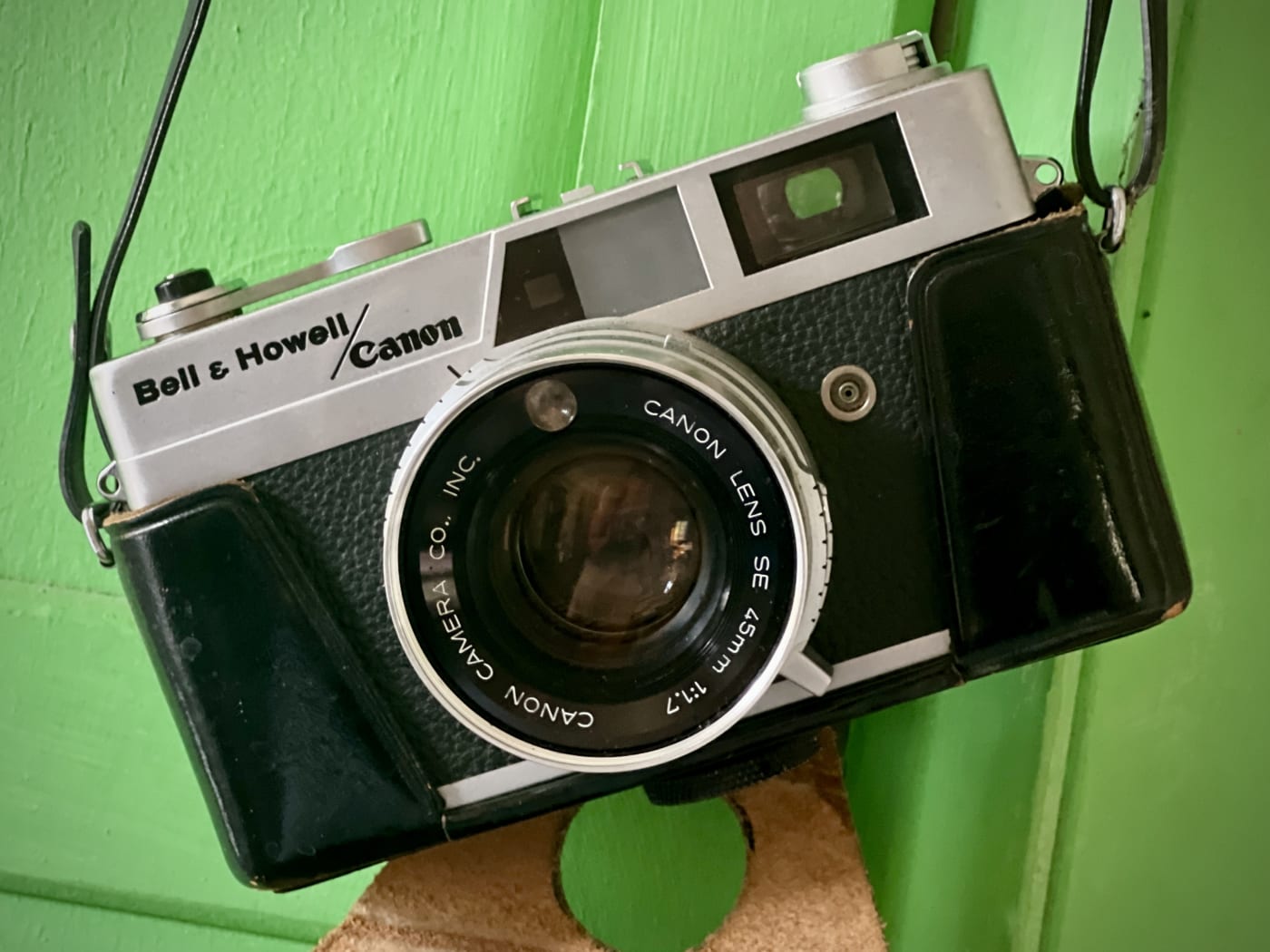
When I was in 6th grade I won a Grand Champion ribbon at the 4-H county fair for a photo I took. That success spurred what became a lifelong love of photography. Using my little Kodak Instamatic I submitted another photo the next year and won Grand Champion again. My grandfather rewarded my success by giving me his 35mm Canon. He’d bought the camera before taking a trip to South America as a delegate for the Soybean Association, but hadn’t used it since. This was a big girl camera that I had to borrow books from the library to figure out how to use. The next year I won Grand Champion again, on a photo I’d taken of him.
I haven’t used this camera in forty years. It still works, but my parents gave me a better one, so this one has sat on a shelf or in a closet all that time. I really should get rid of it. I’ll never buy film for it again. I can’t do it.
Because it isn’t really a camera anymore. It’s the pride and the excitement and the success I felt getting into photography, with that camera along for every step of it. Getting rid of the camera feels, on some level, like getting rid of those feelings — even though I know, rationally, that isn’t true.
If you’ve ever stood in front of a drawer, a closet, or a parent’s entire house trying to decide what to keep, you already know this feeling. Understanding the psychology behind it is the first real step toward letting go.
Why Sentimental Clutter Feels Different From Regular Clutter
Decluttering advice usually treats every object the same way: does it spark joy, do you use it, when’s the last time you touched it. That framework works fine for a drawer of expired coupons. It falls apart completely for an item that means something.
Consumer researcher Russell Belk described why in “Possessions and the Extended Self,” a 1988 paper in the Journal of Consumer Research that remains one of the most cited in the field. His argument is that the things we own become bound up with our sense of who we are, not just what we use. Objects tied to memory and identity aren’t experienced as separate from us; they function almost like an extension of the self.
That’s not sentimentality getting in the way of clear thinking — it’s a well-documented feature of how people actually relate to their belongings. Which means the guilt you feel throwing out the camera isn’t irrational. You’re not just discarding an object. Some part of you is treating it as discarding a piece of the person you were, or the person who gave it to you.
Knowing that doesn’t make the camera easier to throw away. But it does mean the solution isn’t “just get over it” — it’s separating the two things that got fused together: the object, and the memory.
The Actual Problem Isn’t the Object
Here’s the reframe that matters: you don’t need the physical camera to keep the memory. You need something that holds that memory reliably, so your brain doesn’t have to rely on the object as the only proof it happened.
Once that’s true, the guilt around the object itself tends to loosen, because you’re no longer choosing between “keep the camera” and “lose the memory forever.” You’re choosing between two things that both preserve the memory — one that also takes up a shelf, and one that doesn’t.
This is different from the usual advice to “just take a photo and let it go,” which undersells the problem. A photo of an old camera, with no context, doesn’t actually hold the memory — it holds a picture of an object a future version of you (or your kids) will have no way to understand. The photo isn’t what makes letting go possible. The story attached to the photo is.
A Practical Way Through It
- Separate “what do I do with the object” from “does the memory matter.” Do the second one first. If the memory matters, it gets recorded — full stop, regardless of what happens to the object next.
- Record the story before you decide the object’s fate, not after. Once the story exists somewhere safe, the decision about the physical item gets much less loaded. You’re not being asked to choose between the object and the memory anymore.
- Be specific in what you record. “I used this camera as the only photographer for our school’s yearbook” is a better story than “My grandfather gave me this.”
- Decide, item by item, whether it should be kept, passed to someone specific, or let go — now that the story isn’t riding on the decision.
- Let some things go. The point of separating story from object is so you can let the object go without it feeling like erasing something.
What if the Person Who Could Tell the Story Is Already Gone?
This is the hardest version of the problem, and it’s common — a lot of the sentimental clutter people are sorting through belonged to a parent or relative who has already passed, which means the object is there but the explanation isn’t. You can’t record a story you were never told.
What you can do is record what you do know: who it belonged to, what you remember about how they used it or talked about it, and your best understanding of why it mattered — clearly marked as your account, not theirs. That’s not the same as having the original story, but it’s far better than the object going forward with nothing at all attached to it. It also means the next generation isn’t starting from zero the way you might be.
How Many Items Should Get This Treatment?
Not everything needs a full story recorded — that’s a recipe for never finishing. A useful test: if you found this object in a box with no explanation, would you feel a pull to keep it anyway, or would you toss it without a second thought?
The things that pass that test are worth the ten minutes. The rest can go without ceremony, and that’s fine. The goal isn’t to sanctify every possession you own — it’s to stop losing the small number that actually carry weight.
Common Questions About Downsizing Sentimental Items
Is it normal to feel this much guilt over an object that has no practical use?
Yes. This isn’t a character flaw or a failure to “let go properly” — it reflects a well-documented pattern in how people relate to objects tied to identity and memory. Feeling it doesn’t mean you’re doing decluttering wrong.
What if my family doesn’t understand why I’m holding onto something that seems like junk?
That’s usually because they don’t have the story, not because the feeling is unreasonable. This is exactly the gap that recording the story closes — once it’s written down or spoken aloud and saved somewhere, the object stops looking like junk to anyone who learns about it.
Should I record the story even for things I’ve already decided to keep?
Especially those. The items you’re keeping are the ones most likely to get passed down eventually, and the story is what makes the next owner keep it on purpose instead of just never getting around to throwing it out. It’s the same thing that keeps an heirloom from quietly turning back into stuff.
This Is Exactly the Gap KeepSeek Was Built For
I made KeepSeek because I kept running into this same problem, item after item, and generic photo apps and decluttering advice weren’t built for it. It’s a digital keepsake app: you photograph the item, record the story behind it by voice, video, or text, and note who it should go to, if anyone — all before you have to make the harder call about the object itself. Everything stays private until you invite specific family members in to see it.
You don’t have to declutter your whole house this weekend. Pick the one item you’ve been avoiding — the equivalent of my camera — and do that one first. Record the story, then decide, with a clearer head, what happens to the object.
This post touches on decluttering and letting go of belongings tied to grief or loss. If sorting through a loved one’s things is bringing up more than you expected, that’s a normal response to a real loss, and it’s worth talking to someone you trust about it.